Beyond the BMS: A Better Approach to Building Water Quality Monitoring
More data isn’t the answer. Better intelligence is.
Effective building water quality monitoring requires more than simply collecting data.
Modern buildings generate significant volumes of data through Building Management Systems (BMS), online sensors, meters, laboratory testing and manual monitoring.
But collecting more information doesn’t necessarily create greater understanding.
The challenge is determining what needs to be measured, where it should be measured, and how relevant information can be brought together to provide a clearer picture of what is happening across the water system.
This was the focus of D2K Information co-founder Phil Krasnostein’s presentation, Beyond the BMS: From Sensors to Building Intelligence, at the HCAA Trade Expo 2026.
At its centre was a simple principle:
Effective water quality monitoring starts with understanding the system — not with installing more technology.

Start with the water system, not the sensor
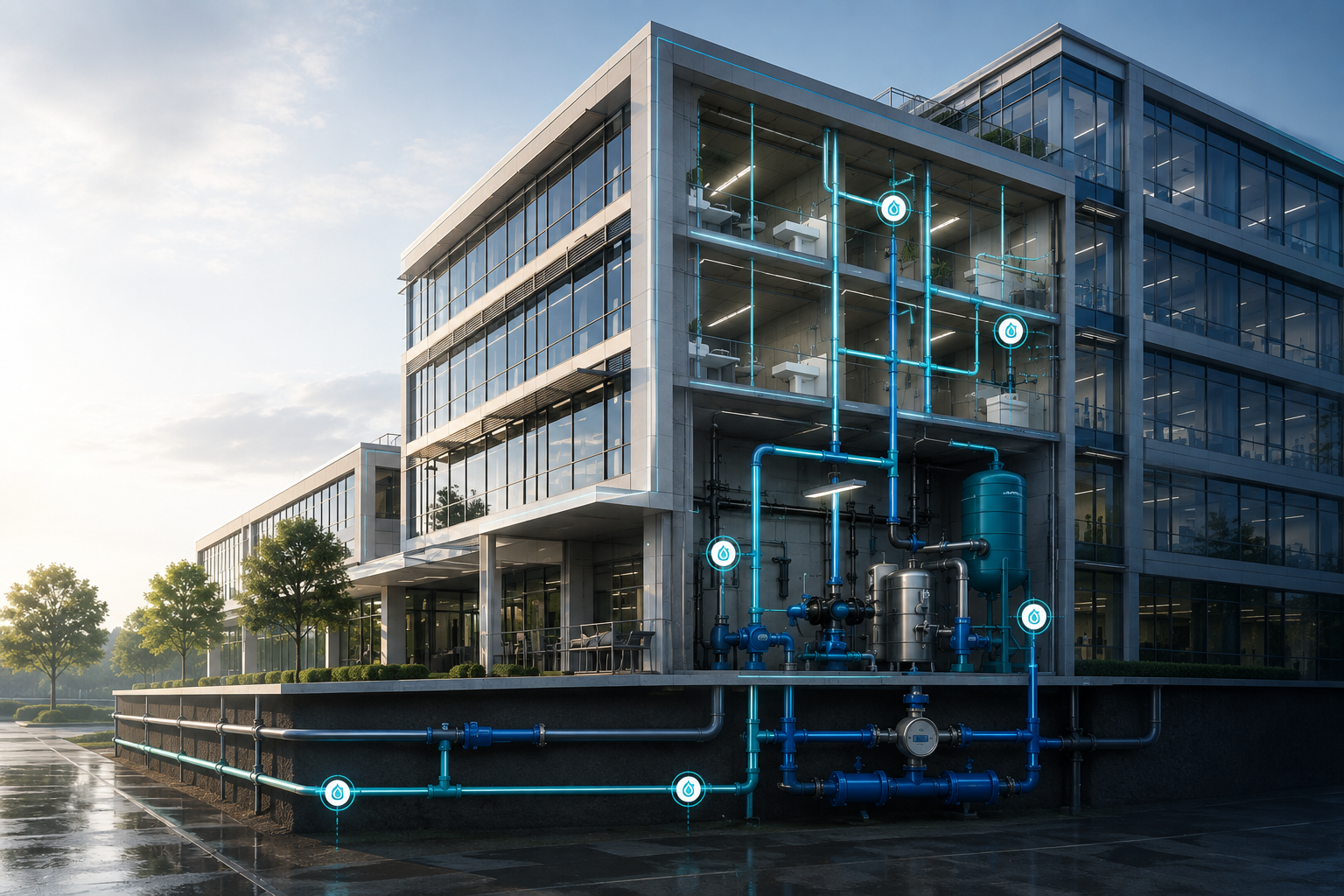
Effective building water quality monitoring starts with understanding how water moves through the building.
That means considering the hydraulics of the system: its flow paths, assets and the locations where meaningful changes or conditions may occur.
From there, monitoring can be designed around the questions an organisation needs to answer:
- What are we trying to understand?
- Where in the system do we need visibility?
- What should be measured at those locations?
- How frequently does that information need to be collected?
- What other information may help us interpret the result?
Instead of beginning with “Where can we install another sensor?”, a better starting point is:
“What do we need to understand about this water system?”
Technology can then be selected and positioned to support that objective.
Better building water quality monitoring isn’t about more sensors
Increasing the number of sensors may increase the amount of data available, but data volume is not the same as operational visibility.
A measurement is most useful when its purpose and context are understood.
Where was it taken?
What part of the system does it represent?
What conditions existed at the time?
How does it compare with previous results?
Are other sources showing a related change?
Without that context, organisations can find themselves managing increasing volumes of information without necessarily improving their understanding of system performance.
Measure where it matters, not simply where it is possible.
Where does the BMS fit?
A Building Management System can provide important visibility into building operations.
For water quality management, however, it may represent only part of the information picture.
Relevant information can also come from:
- online water quality sensors and instruments;
- flow and other meters;
- laboratory test results;
- manual sampling;
- historical monitoring information; and
- operational records.
These sources may be collected at different frequencies and stored in different systems.
The objective isn’t to replace the BMS. It is to complement the information it provides with relevant water quality and operational information when a broader view is required.
From connected data to operational visibility
Bringing different information sources together is valuable, but connection alone doesn’t create intelligence.
A sensor measurement provides one piece of information. A laboratory result provides another. An operational change may provide another.
When those pieces can be considered together — with an understanding of where and when each occurred — teams can begin asking more useful questions:
- What is happening?
- Where is it happening?
- When did the change begin?
- What else changed at the same time?
- Is this an isolated result or part of a trend?
- Does it require further investigation or action?
This is operational visibility: not simply having access to data but being able to see and understand the information required to manage a system effectively.
From operational visibility to Water Quality Intelligence
The next step is Water Quality Intelligence — moving beyond collecting and storing water quality data towards information that supports understanding and decision-making.
The progression can be thought of simply:
Data → Context → Information → Understanding → Action
A measurement provides data. Understanding where it came from, when it occurred, and how it relates to other information provides context. Together, those pieces can create meaningful information and give people a stronger foundation for operational decisions.
This is the type of information challenge D2K’s Information Engine is designed to support.
Information Engine brings complex water quality information together so organisations can organise, analyse and understand it in context.
Technology does not replace good monitoring design or water quality expertise. It helps teams make better use of the information their monitoring programs already generate.
Towards the explainable building
Phil’s presentation also looked further ahead to the concept of the explainable building.
Buildings are increasingly capable of generating data and responding to predefined conditions. The next opportunity is for connected information to help the people responsible for those environments understand what is happening and why.
As Phil put it:
“The future is not simply the smart building — it is the building that can explain what is happening and why.”
For building water systems, that represents an important shift.
Instead of asking:
How much data can we collect?
we can begin asking:
How much can we understand from the information available to us?
Key Takeaways
- Start with an understanding of the water system and its hydraulics before deciding what to monitor.
- Design monitoring around the questions the organisation needs to answer.
- More sensors and more data don’t automatically create better operational visibility.
- A BMS can provide important information, but understanding water quality may require information from laboratory testing, online monitoring, meters and manual sampling.
- Information becomes more useful when it can be understood in context.
- The goal is not more data. It is better understanding that supports better operational decisions.
Common Questions
Can a BMS monitor water quality?
A BMS can provide valuable information about building operations and may incorporate information from connected monitoring devices. However, water quality management can also rely on information outside the BMS, including laboratory results, manual samples, historical records and specialist water quality instruments.
Why are building hydraulics important for water quality monitoring?
Understanding hydraulics helps identify how water moves through a building and which locations are most relevant to the questions being investigated. This can inform decisions about where monitoring should occur and what information should be collected.
Does installing more water quality sensors improve monitoring?
Not necessarily. Additional sensors create additional measurements, but their value depends on their location, purpose and relevance to the water system. Effective monitoring focuses on collecting the right information in the right locations.
From more data to better understanding
Building water systems will continue to generate more information as monitoring technologies evolve.
The opportunity is to ensure that information creates greater understanding rather than simply greater volumes of data.
That means understanding the system, measuring where it matters and bringing relevant information together with the context needed to interpret it.
Because better water quality decisions don’t come from having more data.