
Algorithms
Knowledge driven water management solutions
Microbial Proliferation Risk Potential
Microbial Proliferation Risk Potential
Early warning of a deteriorating microbial proliferation risk profile can be used to help prevent outbreaks, potentially saving lives, illness, financial penalties and loss of reputation. The team of water experts at D2K Information has developed Microbial Proliferation Risk Potential (MPRP), a proprietary virtual sensor that calculates the real-time risk of a water system moving towards the proliferation of opportunistic microbes, including pathogens such as Legionella and Naeglaria fowleri. Enabling users to predict the potential for microbial proliferation enables corrections to be implemented before an outbreak occurs. This advanced warning will help water providers, food and beverage producers, commercial facility managers, and healthcare providers to manage their risks and optimise system performance. Using routine water quality parameters as inputs, the MPRP algorithm can be easily integrated into an existing system, providing information directly from the installation.
Microbial Proliferation Risk Potential
Microbial Proliferation Risk Potential
Disinfection of water, using chemicals such as chlorine or chloramine, requires sufficient contact time for effective microbial pathogen elimination, and is ideally achieved in purpose-built reactors or contact tanks. However, many water supplies rely on disinfection in clear water tanks and reservoirs with varying configurations and levels of short circuiting, leading to shorter-than-expected contact times. To gauge disinfection efficacy, the concept of C.t (concentration of disinfectant multiplied by exposure time) is used, where higher C.t values indicate greater effectiveness. C.t values required, to achieve desired levels of microbial removal, have been developed through scientific research over time.
C.t is normally calculated based on residual disinfection and flow, however, in a real situation C.t is dynamic, and is affected by additional factors (including pH, Temperature, Turbidity). Small changes in these parameters can cause significant deviation from assumed C.t, thus increasing risk.
D2K Information has developed a proprietary virtual sensor considers these additional factors and calculates Dynamic C.t in real time. Dynamic C.t assists in making real time operational decisions on a process’s disinfection barrier, reducing the risk of non-performance and leading to cost savings through optimised use of chemicals.
Dynamic C.t can be implemented in both Information Engine™ Core and can also be incorporated into CCPWatch® demonstrating the flexibility and integrability of our system.
CCP Performance Index

CCP Performance Index normalises Critical Control Point (CCP) performance allowing performance benchmarking and comparison both historically and across facilities. Drawing on the underlying data, this innovative feature allows a single number to be used to track the performance of the most complex CCP, instantly and without the need for further analysis.
AlgaePredict™
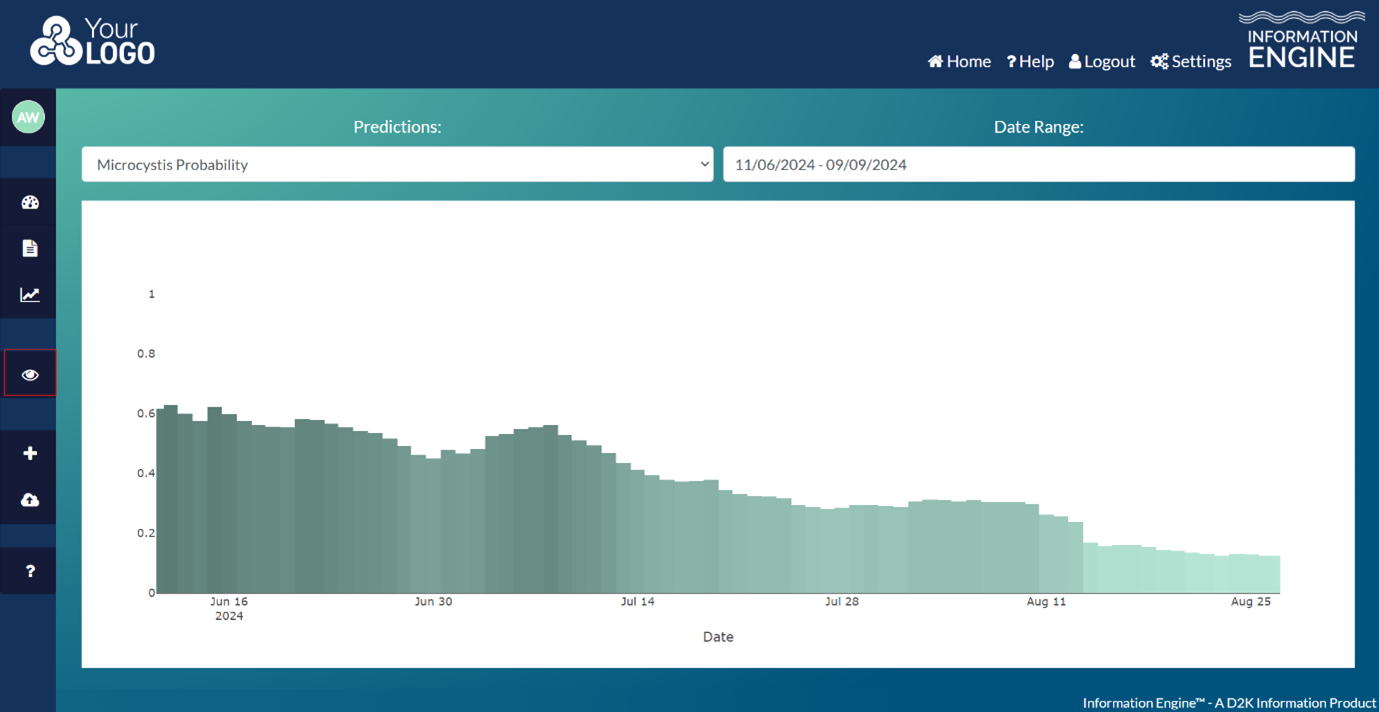
The occurrence of Harmful Algal Blooms (HABs) in any given water body is dependent on many factors including water quality, hydrology, temperature and a range of environmental influences. The D2K Information team established that HAB occurrence could be predicted solely using existing and easily obtained environmental measurements, such as rainfall and temperature, incorporated into a probability algorithm. Algal blooms comprise many different species however cyanobacteria are the most harmful and the species of particular concern, because of their ability to produce dangerous toxins, are Microcystis spp. For this reason, the algorithm has been refined to focus on the bloom prediction of these species.
Costs associated with treating impacted drinking water from surface sources, closure of fisheries and beaches, lost recreation days, and treatment of humans and animals affected by HABs, are significant – impacting communities, and taking up precious resources which could be used for other objectives.
Although much progress has been made on understanding HABs and how to treat them, there has been no effective way to predict when HABs will occur or how intense their effect may be.
Laboratory analysis is costly and time consuming, leading to delayed results. HABs can occur at almost any time, with climate change playing a significant role. While regular sampling and analysis from multiple locations within a water body is an important risk detection tool, collecting input data on HAB analysis, requires special equipment and trained personnel, both of which are resource intensive – and often out of reach for smaller utilities or communities.
Inherent time delays with laboratory reporting means HAB data is historical and may even be received after a HAB event has created an adverse impact. Obtaining effective laboratory data on HABs is often beyond the budget of many organizations, including local water and community-led water utilities – putting these communities at greater public health and economic risk.
AlgaePredict™ is an algorithm which does not rely on labour-intensive, high-cost water sampling and analysis, but instead on accessible environmental data such as rainfall and temperature. The model uses real-time data analysis to generate predictions of the probability (0-0.99) of a Microcystis spp bloom approximately 70 days into the future. Operators can utilise the site-specific prediction capability to programme water body sampling and analysis when Harmful algal blooms (HABs) are most likely to occur, to save your time and resources.
