Utilising Software for Proactive Water Quality Management
Drinking water safety in Australian healthcare settings is central to protecting people who are already vulnerable, from aged care residents to patients in renal units or operating theatres. These environments cannot tolerate lapses in water quality.
Manual water checks, while familiar, fall short when system-wide oversight is required. Water quality can shift within hours, well before a technician arrives with a test kit. Automated online monitoring addresses this gap directly. By tracking water conditions at configurable intervals and integrating rapid alerts, facilities can identify emerging risks early, maintain compliance with Australian regulations, and strengthen risk management across dispersed hospital campuses.
For organisations operating healthcare sites, or Victorian water agencies providing water to such sites, automated online monitoring helps improve water quality outcomes and keeps the community you serve safe.
Hospital Water Systems and Where Risks Begin
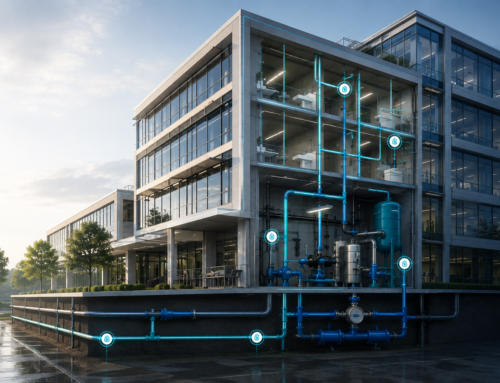
Hospital water networks are often large and complex, stretching across multiple buildings and floors. Hot and cold water lines run through risers and branch into wings and wards, feeding everything from kitchen sinks to surgical scrub areas.
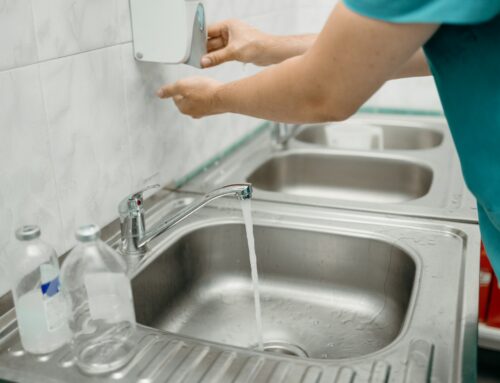
Risks accumulate in areas where water remains stagnant or where temperature control falters. These might include taps in unused consulting rooms, warm water loops with inconsistent return temperatures, dead legs in the plumbing, or storage tanks that do not maintain adequate turnover.
When these conditions persist, they create environments where microbial growth can occur. Research confirms that Legionella pneumophila can persist in hospital hot water systems for years, remaining viable even at temperatures traditionally considered safe. If water flow, temperature, and disinfectant levels are not tracked continuously, these problems can go unnoticed until they present a compliance issue or, worse, a patient safety incident.
Australian Drinking Water Compliance Standards
Water agencies that serve healthcare sites operate in an increasingly strict regulatory environment. Under the expanded Safe Drinking Water Regulations (SDWR) 2025, Victorian water agencies must now monitor critical control points (CCPs) across the entire water network. Victorian agencies must now also maintain compliance with the microbial health-based targets (HBTs) framework of the national Australian Drinking Water Guidelines (ADWG).
Victorian water agencies also have strict reporting requirements, such as Section 22 obligations under the Safe Drinking Water Act (SDWA), which mandates reporting protocols when drinking water contamination is suspected or confirmed.
Delivering this level of documentation is difficult when working from paper logs or manual test sheets that lack time-stamped digital proof. The gap between what regulations demand and what manual systems can provide becomes apparent during audits, when facilities struggle to produce comprehensive evidence of compliance from months earlier.
How Automated Online Monitoring Improves Healthcare Water Safety
D2K Information custom-designed the Information Engine™ software and the integrated CCPWatchⓇ module to deliver automated online monitoring that addresses the shortcomings of traditional monitoring methods. The software connects directly to existing SCADA and telemetry sensors in the water network, so you don’t need a costly overhaul to bring the system online.
Information Engine™ and CCPWatchⓇ track CCPs, including chlorine residual, turbidity, temperature, and flow. Rather than periodic manual checks, these parameters are monitored at configurable intervals, down to seconds or larger intervals if desired. The results are logged automatically, and when readings deviate from safe thresholds, alerts are dispatched immediately via SMS or email to the appropriate personnel.
This approach means staff do not need to wait for scheduled checks or rely on manual observations to identify problems. The Information Engine™ platform builds a complete operational picture in the background, allowing work to proceed while maintaining automated oversight. When an incident requires investigation or an auditor requests historical data, the full record is available immediately, time-stamped, and audit-ready.
The data is stored for up to 10 years in a secure cloud dashboard, with role-based access, meaning there’s no question as to the origin and accuracy of the data.
The level of detail enabled by working with Information Engine™ allows water quality issues to be addressed rapidly, rather than hours after a problem has escalated. It reduces second-guessing, eliminates blind spots in high-risk zones, and provides operations leaders with confidence that their water safety controls are functioning robustly. For organisations operating healthcare sites, the monitoring software offers the same benefits, even in hard-to-access locations across dispersed hospital campuses.
Using Predictive Analytics and Automation to Stay Ahead
Once data is being collected, the next step is using it to anticipate problems rather than simply responding to them.
Information Engine™ and CCPWatchⓇ’s predictive analytics identify unusual patterns or trends that could signal developing issues. If temperature gradually drops in a recirculation loop, or if chlorine fluctuates during peak usage periods, these trends are flagged before they cross into non-compliance territory.
This type of oversight supports informed decisions about inspections and maintenance. It proves valuable not only during a crisis but in preventing one from occurring at all.
Automation also reduces pressure on water agencies’ compliance teams. Instead of spending time compiling paper records or building reports manually, compliance automation pulls everything together. The platform generates logs, incorporates alert notes, and formats documentation for Victorian Section 22 and Regulation 20 submissions. The result is cleaner records, fewer transcription errors, and a streamlined path to audit readiness.
Some facilities have adjusted their maintenance cycles based on predictive data, replacing fixed maintenance schedules with needs-based responses. This has reduced labour costs while improving consistency in compliance performance across the board.
In support of HBTs compliance, Information Engine™ also supports quantitative microbial risk assessment (QMRA) and disability-adjusted life year (DALY) calculations. This provides the quantitative framework needed to demonstrate that treatment barriers are achieving the required pathogen reduction outcomes.
Preparing for the Future of Water Safety in Healthcare
Keeping healthcare populations safe is a task that calls for a modern approach. By deploying technology that delivers timely alerts, automated online monitoring, and predictive risk identification, innovative water agencies and healthcare operators are building safer environments for everyone.
Automated online monitoring shifts teams from reactive incident response to informed, data-driven decisions that help prevent breaches before they start.
Getting Ahead of Risk With Automated Online Monitoring
Improving risk management is not just about saving time or following regulatory steps. Getting ahead of risks means fewer after-hours callouts, lower exposure to fines, and more confidence that safe water is reaching our most vulnerable populations. Systems that offer timely insight, supported by long-term records and rapid alerts, improve outcomes across water agencies and healthcare facilities.
Transforming reactive processes into data-driven decisions starts with the right technology. With D2K Information’s systems, water management leaders are empowered to prioritise public health and prevent breaches rather than just reporting them. Discover our approach to smarter, safer water systems with our software for a water quality manager. To discuss how this could help transform how your operation manages water quality risks, get in touch today.