Preventing Waterborne Pathogens in Healthcare Settings
Keeping healthcare water systems safe is not a simple task. Between evolving regulations like the Safe Drinking Water Regulations 2025 (SDWR 2025), ageing infrastructure, and heightened expectations around patient safety, it takes more than routine checks to stay ahead. For hospital and aged care operators, any delay in identifying a water quality issue could put lives and reputations at risk.
This is why real-time monitoring matters. It provides the ability to track water quality as it happens, not after the fact. Instead of waiting on lab results or reconciling fragmented records, operators can see the current state of the system and act before problems spread. With the support of compliance automation and predictive analytics, we are seeing a shift toward data-driven decisions that prevent harm rather than simply react to it.
Let us take a practical look at how these tools help reduce risk, meet standards, and keep people safe in complex healthcare environments.
Understanding the Risk of Waterborne Pathogens in Healthcare
Hospitals and aged care homes are particularly vulnerable to waterborne pathogens. Conditions like warm water temperatures, stagnant sections of pipe, or underused taps can create ideal breeding grounds for harmful bacteria.
Common culprits include:
- Legionella, which thrives in warm water and can lead to severe respiratory illness
- Pseudomonas, often found in biofilm and linked to urinary and wound infections
- Mycobacterium, which can cause issues in people with low immunity
These organisms do not need much to grow, and once they do, they can spread through showers, taps, humidifiers, and more. Vulnerable patients, including those with weakened immune systems or chronic illnesses, are at higher risk of serious outcomes.
This link between water systems and hospital-acquired infections is well documented. Managing that risk is not a side task; it is core to protecting staff, visitors, and especially patients.
Challenges with Traditional Monitoring Approaches
Many facilities still rely on manual methods for water quality monitoring. This might include periodic checks, waiting for laboratory reports, or depending on staff to report irregularities at outlets.
The result is gaps in visibility that can compromise both safety and compliance. Key issues include:
- Delays in recognising abnormal trends or temperature deviations that could signal stagnation or system failure
- Elevated risk of missing critical failures between scheduled inspections
- Documentation that may not meet the audit-ready standards required under SDWR 2025 and Section 22 reporting obligations
Inconsistent records become particularly problematic in segmented or older buildings with complex distribution networks. The longer a deviation goes undetected, the greater the opportunity for bacterial proliferation and potential patient exposure.
Given the stakes in healthcare environments, relying on fragmented monitoring approaches leaves operators exposed to preventable failures and regulatory scrutiny.
How Real-Time Monitoring Enhances Prevention
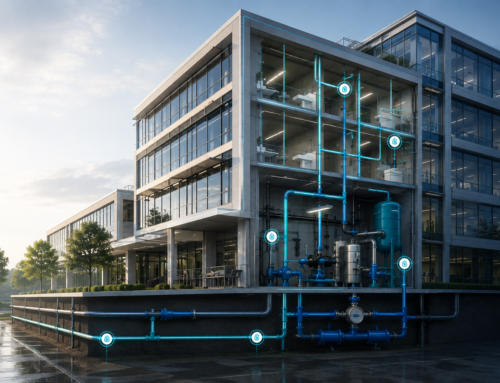
Rather than checking in at set intervals, real-time data capture means continuous system surveillance. By deploying sensors at critical control points, including warm water returns, high-risk outlets, and storage tanks, operators receive a steady feed of water quality data covering temperature, flow, and disinfectant residual levels.
This enables earlier intervention through:
- SMS or email alerts are triggered the moment a reading falls outside defined thresholds
- Automated logging that aligns with Australian Drinking Water Guidelines (ADWG) and Section 22 reporting requirements
- Predictive analytics that identify emerging issues before they escalate into compliance breaches or patient safety incidents
Real-time monitoring represents a fundamental shift from reactive to preventative management. By combining continuous system data with compliance automation, operators reduce the risk of oversights and can demonstrate to regulators precisely how risks are being controlled.
Implementing Proactive Solutions in Healthcare Settings
Effective water protection starts with systematic planning. Success depends on understanding where risks exist across the distribution network and establishing appropriate monitoring at those critical control points.
A structured approach includes:
- Identifying high-risk zones such as recirculating warm water systems, storage tanks, thermostatic mixing valves, and infrequently used outlets
- Deploying monitoring infrastructure capable of capturing data at 2-minute intervals via SCADA/PLC integration
- Configuring system thresholds aligned with ADWG parameters and SDWR 2025 requirements
D2K Information’s CCPWatch™ platform combines on-premise hardware sensors with the Information Engine, a cloud-based analytics system that delivers real-time visibility through secure dashboards. The platform supports instant notifications for compliance breaches, reducing response times and providing site managers with complete oversight across distributed assets.
For facilities working toward Health-Based Targets, CCPWatch™ integrates Quantitative Microbial Risk Assessment (QMRA) and Disability-Adjusted Life Year (DALY) calculations. This enables operators to demonstrate achievement of critical pathogen reduction benchmarks, including 6-log reduction for viruses, 5-log for bacteria, and 4-log for protozoa.
The objective is comprehensive coverage of the distribution system while maintaining operational efficiency. With appropriate digital infrastructure, alerts reach maintenance teams instantly, and reports generate automatically. CCPWatch™ aligns directly with Section 22 reporting obligations, enabling faster response when thresholds are breached.
Establishing automated alerts improves safety outcomes while reducing administrative burden, allowing teams to focus on intervention rather than data collection.
Making Data-Driven Decisions That Hold Up in Audits
Beyond prevention, consistent system data makes a strong case during internal and external reviews. Whether it is a regulator asking for evidence or leadership seeking performance summaries, historical data shows what happened and when.
Some benefits of centralised data capture include:
- Easier access to temperature and disinfectant logs across the full facility
- Data roll-up across multiple campuses without needing manual collation
- Full traceability of risk mitigation steps and intervention times
When auditors or boards ask why a certain decision was made, we can point directly to the numbers. That transparency matters, not just to pass audits, but to build trust with internal and external stakeholders.
Having a searchable digital archive also simplifies trend reviews. We are not guessing what happened three months ago or flipping through spiral notebooks; we are reviewing accurate, timestamped records that support safe, consistent action.
Preparing for the Future of Water Safety
With SDWR 2025 now in effect and heightened expectations around waterborne pathogen prevention, advanced water monitoring capability has become essential infrastructure. D2K Information offers both standalone CCPWatch™ deployments and integration with existing Building Management Systems (BMS), supporting diverse healthcare environments regardless of current infrastructure maturity.
Facilities gain the ability to streamline compliance with tools that automate documentation and reporting, significantly reducing administrative burden while strengthening risk management. Investing in a system that combines hardware, cloud analytics through the Information Engine, and expert consulting demonstrates a long-term commitment to safer, healthier healthcare environments.
Take charge of your facility’s safety with D2K Information’s advanced approach to critical control point monitoring. Detect potential risks in real time and streamline your response before problems escalate. Empower your team with data-driven insights for a safer, healthier environment. Connect with us today to build a smarter water management strategy that puts prevention first.