Detecting Early Warning Signs of Hospital Water Contamination
Managing water systems in hospitals is difficult when you’re using manual, outdated approaches. Older testing methods often struggle to keep pace with regulatory and safety expectations, especially when water contamination risks can manifest in hours, not days.
The moment something goes wrong, the consequences can be devastating, especially for patients who are immunocompromised. Additionally, hospitals face pressure to comply with stringent regulations while striving to prevent operational failures.
Preventing water safety issues begins with spotting them early. Hospitals need to adopt a proactive approach to prevention and maintenance, utilising tools that can flag early risks before they have a chance to spread throughout their water systems.
By identifying problems before they escalate, they can take swift action, rather than reacting after a waterborne outbreak. For those committed to protecting water quality in healthcare, embracing a preventive strategy is a safer and more responsible path.
The Crucial Role of Early Detection in Hospital Water Safety
Hospital water systems are often complex, with layers of infrastructure delivering water to a wide network of taps, showers, cooling towers, and medical equipment. These systems supply everything from drinking water and sterile water for medical procedures to cooling HVAC systems. If the water supply becomes contaminated anywhere in the system, everyone’s at risk.
Common waterborne threats in hospitals include bacteria like Legionella, Pseudomonas, and E. coli. They can multiply rapidly, especially in areas with poor water flow or inconsistent temperature control. When these organisms inundate the water, they will disrupt hospital services and severely reduce the quality of patient care.
Patients may not exhibit physical symptoms immediately, which gives these contaminants time to spread undetected if not closely monitored. Clearly, a reactive approach presents a significant risk to patient care.
The longer a problem resides in the water system, the wider the exposure risk. Contaminated water doesn’t just lead to illness. It can lead to forced shutdowns, failed safety inspections, negative press, reduced staff confidence, and, worse still, deaths. For hospital and water operations managers, there’s no room to rely on outdated logbooks carrying yesterday’s data.
Hospital-acquired infections (HAIs), infections acquired while patients are under hospital care, are a global problem. The path forward is to shift from reactive testing to data-informed vigilance.
A good early warning system doesn’t just tell you what went wrong; it helps you see what’s going to go wrong. This strategy changes how facilities teams maintain systems, manage compliance, and prioritise public health as their top priority.
Methods For Detecting Early Warning Signs Of Water Contamination
The first step in implementing early detection is to use the right tools. Here is a breakdown of your options when it comes to identifying early warning signs:
1. Real-time Water Monitoring Systems
Many facilities still rely on manual sampling and laboratory testing, usually done weekly or fortnightly. While this has been standard for years, it’s easy to miss fast-moving risks. There’s a time lag between collecting, sending and receiving results. In that window, a localised issue could become a network-wide problem.
A real-time water monitoring tool can track variables such as temperature, pH levels, turbidity and chlorine levels. As soon as readings move outside safe thresholds, the system can send alerts to your team for further investigation.
2. Predictive Analytics
This technology uses historical and real-time data to forecast potential risks of water contamination. For instance, if certain temperature and flow combinations have previously led to bacterial growth, the system can flag when those conditions reappear, giving your team the chance to initiate contamination prevention strategies.
3. Compliance Automation
You can set up an automated routine to collect, store and organise water quality data according to specific hospital standards. This takes pressure off internal teams who might still be logging data manually and reduces the chances of human error during audits or inspections.
Hospitals embracing real-time monitoring and predictive analytics are finding it much easier to make data-driven decisions. They don’t have to guess where or when a problem might crop up next.
These subtle signs prompt early intervention, preventing bacterial growth before it takes hold. With the old system, these types of issues wouldn’t have been spotted until symptoms appeared or lab reports came back days later.
Teams can take a preventative approach, adjusting water treatment or maintenance before a complaint is ever logged. Better outcomes often start with better tools. In hospital settings, better tools mean providing your team with the correct information at the right time.
Establishing a Comprehensive Hospital Water Quality Monitoring System
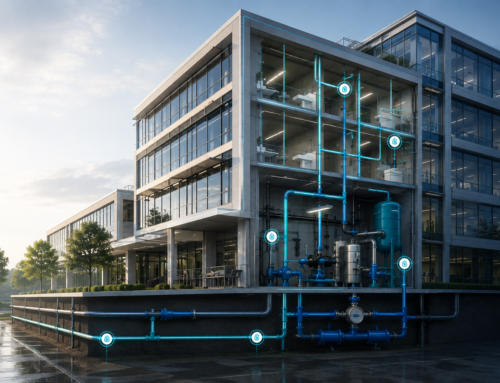
Achieving the most from real-time monitoring and predictive analytics begins with a clear and structured implementation process. Hospital water systems can be complex, spanning multiple storeys and critical care areas, which means any monitoring approach needs to account for site-specific infrastructure, historical risks, and compliance demands.
These are general recommendations to roll out a proactive monitoring strategy:
1. Audit the entire water system
Start with a comprehensive map of the water network to identify vulnerable spots with stagnant water conditions, underutilised water outlets, and inconsistent temperature zones. These areas often show the first signs of bacterial growth or flow disturbances.
2. Set up real-time monitoring devices
Install smart sensors at key risk points, especially for storage tanks, taps on long pipe runs, and cooling systems. The data collected here will reveal crucial inflection points when abnormalities occur in the water.
3. Enable data analytics
Connect monitoring assets to an online software platform that can analyse trends and raise alerts automatically. This provides water operations staff with live data analysis of system conditions and flags deviations, presenting accurate information on water quality data.
4. Apply predictive models
Predictive models rely on a vast amount of data to identify seasonal risk patterns and recurring anomalies. Over time, this unlocks accurate insights, especially when unexpected temperature drops or equipment failures lead to microbial growth.
5. Link with compliance workflows
You can link water data and reports with established Australian water standards and internal hospital policies. Smart water monitoring systems can generate compliance logs, audit documents, and quick reports ahead of inspections or reviews.
6. Establish staff training and system maintenance
To fully leverage the benefits of new water monitoring software, it’s crucial to establish comprehensive staff training so your team can confidently operate and interpret the system.
Regular system maintenance is also essential to ensure the software remains accurate, reliable, and continues to provide the critical insights needed for proactive water safety. By investing in both people and technology, you’ll safeguard your hospital’s water network and, most importantly, patient health.
Conclusion: Maintaining Long-Term Water Safety In Hospitals
Maintaining water quality that protects patients and satisfies regulatory requirements relies on more than short bursts of activity. Water safety cannot rely on guesswork and manual procedures.
Hospitals will benefit from consistent practices centred on risk reduction, and those practices need to utilise modern software with real-time capabilities. These long-term strategies are most effective when all stakeholders have access to the same data on a central cloud-based platform.
When coupled with a robust infection control and prevention program, hospitals can achieve superior water safety outcomes, protecting patients, and ensuring regulatory compliance across all critical areas.
At D2K, we provide an advanced water management software that’s designed to meet the complex needs of hospitals. Start your journey to safer water today by exploring how our online software can support stronger, more reliable water quality management.